
Come and See Me at the Intersection: Navigating My Gender Identity, Faith in Christianity, and Mental Health
God, I love you, and I know you love me. You have made me who I am today, and I believe you make no mistakes.
From a young age, I loved wearing skirts and playing with dolls. I never thought there was anything unusual about it. After all, what’s wrong with a girl wearing a skirt or playing with dolls? But growing up in a patriarchal and heteronormative society, I eventually realized that people saw me as “different.” My parents often scolded me for wearing my sister’s clothes, and I always envied her beautiful, pink outfits. Despite my longing, I didn’t question why my parents insisted I dress differently.
As I grew older—around the age of 10—I became aware that I might indeed be different. At school, I was called achult, an informal Burmese term for “transgender,” meaning “dry.” I was bullied, humiliated, and demonized for simply looking, acting, or behaving differently.
In Burmese culture, being born male is considered a blessing from God, as it comes with hpone. Hpone is an intriguing concept, loosely translated to mean “men’s luck,” masculine power, or authority. Because women are not born with hpone, they are seen as subordinate in society. Being male comes with certain advantages: men have authority over family members, can become monks, and are allowed access to areas in temples that are forbidden to women. People often asked me why I wasn’t happy with my assigned gender and why I wanted to change when I’d been “blessed.” Their questions implied that I had chosen my gender, as though it was a deliberate decision. But at that young age, I didn’t even know what gender truly meant, let alone understand the expectations tied to it—a misconception many people hold. Being so young, I couldn’t articulate an answer. That question, however, haunted my childhood.
At the same time, my faith deepened as a Christian, driven partly by our poverty as I sought both spiritual guidance and hope. I remember vividly spending entire days at church. I loved being at church. Growing up poor meant worrying daily about our next meal. Prayer was the only mean of survivor. My mother, a devoted Christian, passed her faith on to me, and I learned about Christianity through her. I prayed, attended church, and read the Bible, trusting God would help us escape poverty so we wouldn’t have to endure hunger. The more I attended church and prayed, the closer I felt to God. I believed in Him wholeheartedly and never questioned His existence. I trusted him, and I knew He was with me all the time.
In the Christian community I grew up in, unlike in Buddhist beliefs, we did not believe in hpone—the spiritual essence that governs luck and fate. But the Church was strict in enforcing the gender binary, insisting that only male and female identities existed, with no space for anything beyond. To be trans or gay meant being marked as a sinner, regardless of who you were or how you acted. Verses from scripture, like Leviticus 18:22, were cited as judgments against the LGBTQ+ community, myself included.
As a child, I didn’t dare question this authority. I turned that judgment inward, believing it was my fault for being different. I wanted so badly to be better, to be “normal.” I yearned to fit in, to be accepted—not to be a sinner, but to be someone worthy of heaven. More than anything, I loved God. And in my heart, I wanted to believe He loved me back.
Overall, I was a good kid. I did well in school, helped with household chores, and worked with my family selling food on the streets. I took care of my younger brothers and sister. But somehow, I was never the perfect child.
Family members often reminded me of how I brought shame to the family, of how I dishonored them. One night, my father told me he loved everyone—except me. I cried silently, unable to make a sound. No matter how hard I tried, I would always be different, the child who brought shame to the family.
Despite the bullying, I have to admit that life in Burma wasn’t as hard as it could have been. Although my family and community often mocked and humiliated me, I learned to ignore their jokes and insults. The boundaries between normal and abnormal, good and bad, justice and injustice, violence and tolerance, discrimination and acceptance—all felt blurred. Technically, homosexuality is illegal in Burma, but the law is rarely enforced. I wasn’t seen as a threat as long as I stayed quiet, as long as I kept my head down. So long as I remained invisible, I would be safe. I was reduced to an object to be mocked, a punchline, or someone who could be treated as less than others.
But when I came to America alone, leaving my family behind, these lines sharpened. The dichotomies of good or bad, gay or straight, pure or evil, cis or trans were suddenly unavoidable, and I felt like an outsider. I didn’t belong. I didn’t have blond hair or even straight hair. I wasn’t male or female in the ways people expected. I checked none of the boxes—straight, male, female, rich, white, beautiful. Instead, I was Asian, a refugee, an immigrant, and queer (trans).
In America, for better or worse, gender identity and sexuality are deeply political subjects. People openly debate whether LGBTQ+ rights are a matter of human rights or a sign of moral decay. Liberals argue that LGBTQ+ rights are fundamental, while far-right religious groups condemn these identities as sinful. Conservative and far-right religious fundamentalists often target LGBTQ+ individuals, citing the Bible to justify their actions. For example, they frequently reference the Sodom and Gomorrah narrative (Genesis 19:1–29). This rhetoric, rooted in selective interpretations of scripture, continues to persist today. I never imagined that life in America would feel so different from what I’d hoped. Somehow, I felt safer in Burma than here, in the so-called land of freedom, democracy, and rights. Could that really be true? Was I dreaming? Where was the American Dream I had envisioned?
In Burma, I was mocked and humiliated, but my existence wasn’t a political issue. Here, however, my identity was suddenly a topic for public debate. This left me feeling both seen and invisible in strange, unsettling ways. People weren’t just questioning who I was—they were questioning whether I even had the right to be, especially within conservative Christian circles. The weight of this realization was overwhelming. Here, I wasn’t just “different.” I had become a symbol, a controversy, a topic to be dissected.
Despite these challenges and the cultural shock, I continued my studies in college. Again, I worked hard, studied diligently, and followed the law. I was a good citizen—I paid taxes, volunteered, and helped my community. Yet, somehow, it still wasn’t enough.
In Rochester, there’s a small Burmese community, many of whom are conservative Christians with strong, unyielding traditions. Some told me outright that I was bound for hell—that I was a sinner, not a true believer. They claimed my faith was wrong, that I wasn’t a real Christian. Some would look me in the eye and say, “You will go to hell. It’s in the Bible. You will never see heaven.” I would just smile and stay silent, but the truth was, I didn’t know how to respond.
These words terrified me. I began to lose trust in people. I withdrew, isolating myself without even realizing it. I wasn’t sure if I was being left out or if I was choosing to stay away. I ate alone—at work, at school, and at home. I spoke less and less and could count my friends on one hand. The fear of being judged held me back, and so I pulled away from my community. I started to build fears. Would I be killed? Would I be murdered? Would I ever feel safe again, in my apartment, at my workplace, or even in public?
Over time, these harsh realities built up in my mind, creating symptoms of what I would later understand as mental health struggles. At first, I didn’t know what it was. Mental health wasn’t something we talked about in Burma. There, it wasn’t addressed, discussed, or even acknowledged. Mental health carried a deep stigma—if you had mental health issues, you were seen as stupid, crazy, or mentally disabled.
I refused to get help. Or maybe I just didn’t know where to seek it as a new refugee. Maybe it was both. I was terrified of being labeled “crazy.” Deep down, I knew I wasn’t, but shame kept me silent. I worried that reaching out would make me feel even more vulnerable, more out of control. What if people in my community found out? What if they judged me? Made fun of me? What if…
So, I became my own therapist.
One minute, I was happy; the next, I was overwhelmed with sadness. I wondered if I had bipolar disorder.
Countless nights, I lay awake, unable to sleep, and I questioned if I was struggling with depression or anxiety.
Unwanted memories resurfaced, nightmares haunted me, and I couldn’t shake the thought—could this be post-traumatic stress disorder (PTSD)?
I started avoiding people, afraid of rejection and criticism. I wondered if I had avoidant personality disorder (AVPD).
At times, my self-esteem plummeted. Intense anger, insecurity, and feelings of worthlessness overwhelmed me, and I questioned if I might have borderline personality disorder.
Some memories of my childhood were gone, lost to the past, and I wondered if trauma had erased them.
And the list went on…
One day, without even realizing it, I found myself standing in front of a mental health clinic. I didn’t know how I’d ended up there, but there I was, rooted in place. Yet, I couldn’t go inside. The thoughts came flooding back. What if I ended up in a mental hospital? What if people mistreated me? What if I lost my job and became homeless? Lost my apartment? What if people called me crazy? What if I never finished college? What if…
And so, I didn’t go in. I still didn’t seek help.
That day when I got into my apartment, I remember crying out loud for the first time, louder than I thought I ever had in my life. I don’t think I had ever cried that much before. I didn’t know where all those tears were coming from: sadness? Exclusion? Anger? Was I going crazy? Had I lost my mind? I didn’t know. All I knew was that I had cried so much I could barely breathe.
For the first time, I began to blame God. I cried out, “God, if I love You this much, how could You not love me back?” I held Him responsible for everything: my life, my gender identity, my struggles, my pain, my mental health. The list went on.
For the first time in my life, I wanted to die. One day, I sat on my bed, unable to move or muster the energy to do anything. I must have been sitting there, motionless, for almost 30 minutes. Then, my eyes accidentally landed on a bottle of ibuprofen across the room. Without thinking, I grabbed it, opened the bottle, and poured all the pills into my hand—about 20 of them. I almost put them in my mouth.
Suddenly, a vivid memory stopped me. I thought of my uncle—my mother’s brother—who had died by suicide. I was so young at the time; I hadn’t understood why he did it. But I remembered the mourning that followed, the grief etched on everyone’s faces. I also remembered the words of my family: if someone takes their own life, they are destined to repeat the act at the same age in each of their next seven lives. That thought terrified me.
When I became fully aware of myself again, I saw that the pills had fallen from my hand and scattered across the floor. I quickly swept them up and threw them in the garbage. But even after that, I couldn’t shake the doubt. Had I made the right choice by throwing them away? Or should I have taken them? To calm myself, I opened the Bible and began reading slowly. Gradually, I felt myself steady again.
However, from that day forward, I blamed God daily. There were countless days when I begged Him to take my life, feeling utterly worthless. I told Him I couldn’t bear the pain any longer, pleading, “Take my life away; I would rather die than keep suffering.” I questioned endlessly: God, why won’t You take my life and let me be at peace? Why do You allow me to suffer? How much longer must I endure this? Why did You create me this way? Did You make a mistake? Why don’t You fix it? Why do others mock me and humiliate me, and you let them do it? The questions piled up, unanswered.
But somehow, in unimaginable ways, my faith in Christianity grew stronger and stronger. The more I challenged God, the more He seemed to answer my prayers. The more I hated Him, the more He loved me. The more I asked, the more He gave.
Then, I found this church called Lake Avenue Baptist Church. I had never thought there would be a church that would accept me, but this one did. I was welcomed, embraced, and included. There, I found strength, self-esteem, and love. They taught me what it means to be a true Christian—showing love to those who have been excluded, refugees, immigrants, the poor, and LGBTQ+ persons.
Second, despite all the challenges, I completed my bachelor’s degree with prayers. It wasn’t easy, but I did it. Then, I found a well-paying job and decided to continue with a master’s degree, and eventually, a Ph.D. Coming to America at 18 as a refugee, I barely spoke English. I remember using an interpreter just to navigate government paperwork. Never in my wildest dreams did I imagine someone like me could earn an associate’s degree, let alone a Ph.D.
Third, I found friends who accepted me without judgment. I learned that there are people who truly love and value you. These friends became important parts of my life, helping me realize how to distinguish between those who are genuine and those who are not. I learned to ignore and distance myself from negative influences, discovering that the world isn’t as harsh as I once thought.
Finally, I came to understand that God sent me to Rochester, New York, for a purpose. I could have been sent to Mississippi or Alabama, where I might have faced danger. I could have ended up in Missouri or Kansas, where life could have been much harder or just different. I am deeply thankful that He brought me to Rochester—a city I am proud to call my hometown, where immigrants, refugees, LGBTQ people, and other minorities find a more welcoming community.
When I realized these blessings, my life began to change for the better. My coping mechanisms became reading the Bible, attending church, praying, making friends, and volunteering. Slowly, I began to love myself. I began to embrace identity. I learned to love and value who I am. I practiced self-care through cooking, traveling, reading, studying, and watching TV. I made new friends and began opening up to them. I also started to rebuild my relationships with family members. I took warm showers, enjoyed a glass of wine, and dressed up when I needed a boost. Without realizing it, I started sleeping better, eating better, and simply feeling good. I learned to love who I am—the way I dress, the way I speak, and the way I behave. I learned to ignore negative comments and began thinking more positively.
I also realized that God had been with me all along. He protects me and loves me. There’s no doubt: He didn’t make a mistake. He created me just as I am, and He is proud of me. He has a plan for me; He chose me. With this realization, I found the courage to speak up. I became more involved in the community by volunteering, participating in church activities, and standing up against injustice. I joined rallies and protests, educating my community on immigration issues, mental health, and LGBTQ issues.
If God loves someone like me, then why does the faith I hold dear—Christianity—continue to oppress minorities? As I look forward, I understand through prayer, reading Bible, and life experience that it’s not Christianity itself that oppresses us, but rather certain individuals within it—especially those rooted in religious fundamentalism. They frequently cite specific passages from the Bible, such as Genesis 19:1–29 and Leviticus 18:22, to justify their condemnation. However, they often ignore verses like Matthew 19:12, 1 Corinthians 6, and Galatians 3:28—texts that emphasize love, compassion, and inclusivity.
Unfortunately, much work will still need to be done, especially in the political climate we are heading into and with the rise of religious extremism. The next Trump administration is expected to target transgender people and the broader LGBTQ+ community through policies and bills aimed at rolling back their rights. For example, they may ban transgender individuals from serving openly in the military, attempt to define gender strictly based on biology at birth, and rescind protections for transgender students in schools, including access to bathrooms aligning with their gender identity. These actions will likely be part of a broader strategy to use trans issues as a political tool, exploiting fear and misinformation to rally their base and deepen societal divisions.
Yet, I will remain hopeful. I will continue to believe in God, in people, in justice, and in democracy. I will stay committed to helping build a world where everyone, no matter who they are, can experience the love and acceptance I believe God intended.”
did. Please seek professional help if you need it. Love to you all.

Thank you all for taking the time to read this essay. It reflects my personal journey as I navigated my gender identity, faith in Christianity, and mental health. As a very private person, I rarely share my story, so consider this a special moment. This is the first time I’ve opened up in this way, and I believe now is the time to speak out. Amid the rise in hatred, bigotry, and Christian extremism, I feel compelled to share my journey and let the world know my truth. The truth is that none of us chose to be male, female, or non-binary. God created us as we are, with intention and purpose. He made us this way, and we are all part of His design.
In this essay, I aim to convey several important messages:
- Embrace yourself, no matter who you are. You are beautiful, and you are worth it. There will always be people who judge or try to bring you down but remember: there are even more who will love and embrace you.
- If you’re struggling with mental health, don’t hesitate to seek help. Many organizations are available to support you, such as the Crisis Line (988) and the National Suicide Prevention Lifeline (1-800-273-8255). Don’t ignore your mental health—reach out if needed. Don’t struggle alone, as I once did. There is no shame in experiencing mental health challenges. Practice self-care, even if it simply means drinking a glass of wine or staying away from negativity. I work to raise awareness and advocate for mental health within my community. Remember, experiencing mental health symptoms doesn’t make you “crazy” or “stupid.”
- There are many LGBTQ resources in the community. For example, Trillium Health in Rochester and The Trevor Project offer support via phone, chat, and text for LGBTQ+ youth (thetrevorproject.org/get-help-now/).
- If you are a therapist working with diverse clients, it is essential to adopt a trauma-informed and culturally competent approach. This may involve speaking slowly, using an interpreter when necessary, expressing empathy both verbally and nonverbally, and asking questions in a nonjudgmental manner. In some cultures, mental health carries a significant stigma, which can lead clients to resist seeking help. Therefore, it is crucial for therapists to understand the unique needs and barriers their clients face to provide effective and compassionate care.
- To my fellow believers, remember that religion itself does not oppress us. It is the actions of people that cause harm. Don’t lose hope in your faith; instead, speak out against religious fundamentalism and support the separation of church and state. As a devoted Christian, I believe we are all equal in the eyes of God.
- Make sure to speak up. Get involved in local grassroots movements and participate in rallies or demonstrations to drive change. Speak out against hatred, stand up against injustice, and let your voice be heard.
- Finally, to my critics (HATERS)—I forgive you. I’ve accomplished much in my life, and through it all, I’ve learned that love prevails.
Remember: you are beautiful, loved, and valued. God does not make mistakes. Mental health is just as important as physical health, so take care of yourself. Don’t ignore any mental health symptoms, as I once
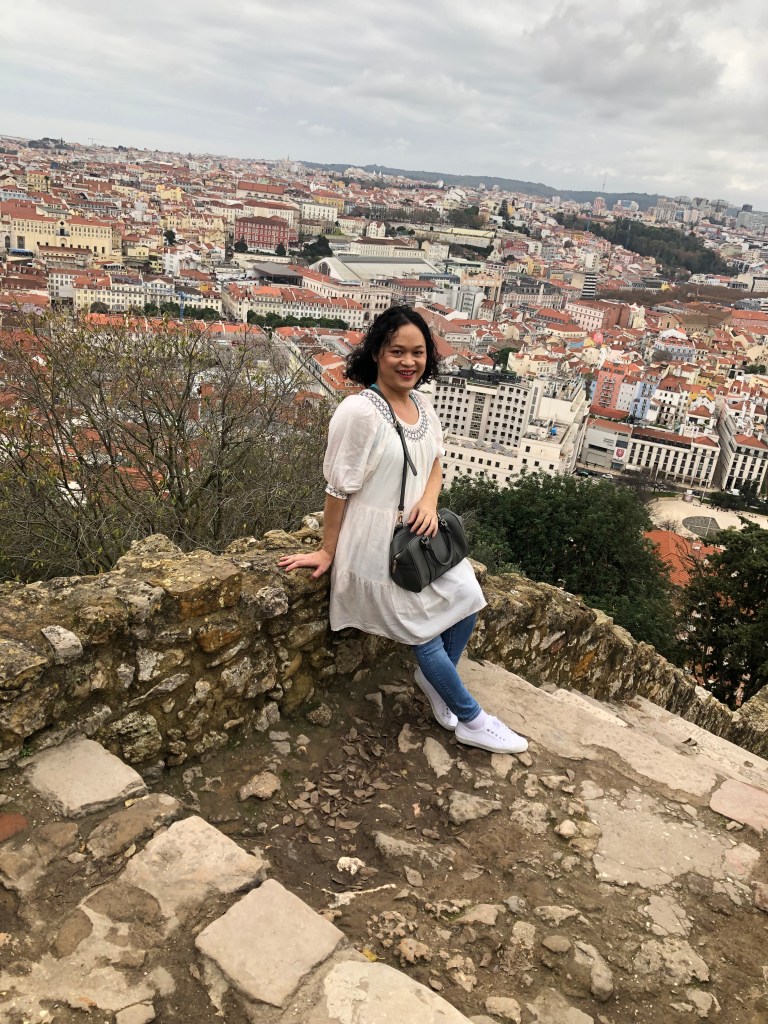
I came to America alone as a refugee in 2007. Although I faced many challenges, I never gave up. Today, I consider myself both a scholar and an activist. I recently earned my Ph.D. in Global Gender and Sexuality Studies from the University at Buffalo, where my research focuses on human rights, including women’s rights, minority rights, and LGBTQ rights, global gender inequality, and gender in politics. My dissertation examined the women’s movement in Burma. Currently, I teach part-time in the Department of Women and Gender Studies at SUNY Brockport. Two of my articles on women’s rights and ethnic rights in Burma are in press and will be published next year. I am also working on my book, Feminism in Burma.
(This picture was taken from Lisbon, Portugal.)
 Madwomen in the Attic
Leave a comment