From Lady in Green to Psychiatric Survivor:
How 988 Shattered My Trust in the Mental Healthcare System
By Emily Wu Truong
For over a decade, I devoted my life to mental health advocacy. I believed in change — in compassion, in awareness, in recovery. My journey began with my local chapter of the National Alliance on Mental Illness (NAMI), where I first found community when my family did not know how to be a support to me. Later, I connected with the Los Angeles County Department of Mental Health (LACDMH) and joined the California Mental Health Movement, back when it was still called Each Mind Matters.
As part of their campaign promoting the lime green ribbon for mental health awareness, I became known as the Lady in Green. They featured my story. I felt validated. I spent years fighting stigma, amplifying AANHPI (Asian American, Native Hawaiian, and Pacific Islander) voices, delivering nearly 200 talks, and working within a system I believed could help people heal.
In 2022, when the national 988 crisis line launched, I called and texted the line to test it — to better understand what others in crisis might experience. A year later, I called again. But this time, it wasn’t a test.
On July 29, 2023, I called 988 because I was struggling with suicidal thoughts. I was grieving deeply — my father had passed away less than a year before, and I felt like my life was unraveling. I was looking for a lifeline, for someone to help me carry the weight. But the person on the line — a man named Mark — didn’t hear distress. He heard danger. And once that switch flips in the system, there’s no going back. Mark had 911 called on me.
The police arrived. I was placed on a 5150 — an involuntary psychiatric hold. My rights, my autonomy, my dignity were taken from me, piece by piece. I was transported to USC Arcadia Hospital, where I was never informed of my patient rights. No one explained what was happening. I wasn’t given space to speak, let alone to be heard. It was so dehumanizing.
At one point, the rude nurse who had taken away my smartphone without explanation tried to make small talk with me.
“So, what do you do for a living?” she asked.
I answered, “I’m a suicide prevention advocate.”
She looked at me, incredulous. “Then what are you doing here?!!!”
Her words stung more than anything else I heard that night.
What could I say? I really didn’t want to be there seeing how I was being treated. But I stayed — not because I trusted the hospital, but because I feared what might happen if I left. I knew the stories. I knew what happened to people like Jazmyne Ha Eng, who was killed by police in 2012 during her own mental health crisis. I didn’t want to become another name in a list of preventable tragedies. Another headline. Another face on a memorial graphic.
So I stayed. Not because the system felt safe — but because leaving felt more dangerous. I did not want to be killed by the police for wanting to walk home.
The resident doctor didn’t offer me options or understanding. Just orders. I kept thinking about how many times I had told people that seeking help was brave. And now, sitting under harsh fluorescent lights, stripped of choice and treated like a risk, I realized how complicated that “help” really is.
I was later transported to Kaiser’s Mental Health Center on College St. The doors were like being taken to a jail. Why was I being incriminated? There were so many issues with that place. Too much to explain. So many grievances. No real mental health support. No support groups. Other patients there confided in me about their own frustrations about the space. If I could sum up what this space was – it was an adult-babysitting service by TV with medication management.
After the experience was over, then came the bill. It was over $3,000 for a 50-hour hospital stay I never consented to. For care that didn’t feel like care. I wasn’t offered real treatment. I wasn’t listened to. I wasn’t respected. And somehow, I’m expected to pay — not just emotionally, but financially.
It’s hard to explain that kind of betrayal unless you’ve lived it. It’s not just the money. It’s the deep and quiet violence of being failed — and then charged for the failure. You realize the system doesn’t just fail people. It profits from that failure.
Sometimes I joke — half seriously — that I should write a play about these 50 hours. A dark comedy, part truth, part satire. Maybe even consider inviting Jack Nicholson to show him how nothing has changed since his own psych ward experience in his film One Flew Over the Cuckoo’s Nest. I imagine a scene where someone calls 988 for help and ends up in a Kafkaesque hospital ward, stripped of their phone, their rights — then handed a $3,000 bill on the way out, along with a “customer satisfaction” survey.
But underneath the humor is something else: a warning. A truth I never wanted to learn.
This can happen to anyone.
Even to someone like me — someone who hoped to believe in this system. Someone who worked for change. Someone who thought that asking for help was always better than suffering in silence.
I still believe in compassion, but now I know: compassion without accountability isn’t care.
So think twice before you call 988.
Consider the Wildflower Alliance as a resource. Sera Davidow and Rob Wipond were among the first individuals to reach out to me to validate my story.
I Secret Shopped #988 and Three Cop Cars Showed Up Outside My House by Sera Davidow
Dramatic Rise in Police Interventions on 988 Callers. By Rob Wipond, Author of “Your Consent Is Not Required: The Rise in Psychiatric Detentions, Forced Treatment, and Abusive Guardianships”: https://robwipond.com/your-consent-is-not-required
It is very important for the public to be well-informed of the dangers of calling 988.
I’ve personally filed a grievance with 988 / Vibrant Emotional Health, but I’ve only gotten pushback from them. They told me that the only way they would continue speaking with me was if I got a court order or subpoena. Based on my personal experiences with 988, I will not call 988 ever again. I personally cannot promote 988. I cannot promote a program that can potentially call 911 on its callers and have them placed in a situation where their patient’s rights were not explained to them and where they are given psychiatric medications without their consent.
The Wildflower Alliance in Massachusetts was the only organization who acknowledged my grief from the traumatizing experience. They were the only organization that truly made me feel seen and heard. They featured me in these 2 webinars. Over 180+ people nationwide attended this virtual webinar, and even my friend in Singapore affiliated with the Center for the Human Rights of Users and Survivors of Psychiatry woke up in the middle of the night just to join the 1st webinar.
I would also like to share with you this report called “The Problem with 988: How America’s Largest Hotline Violates Consent, Compromises Safety, and Fails the People.”
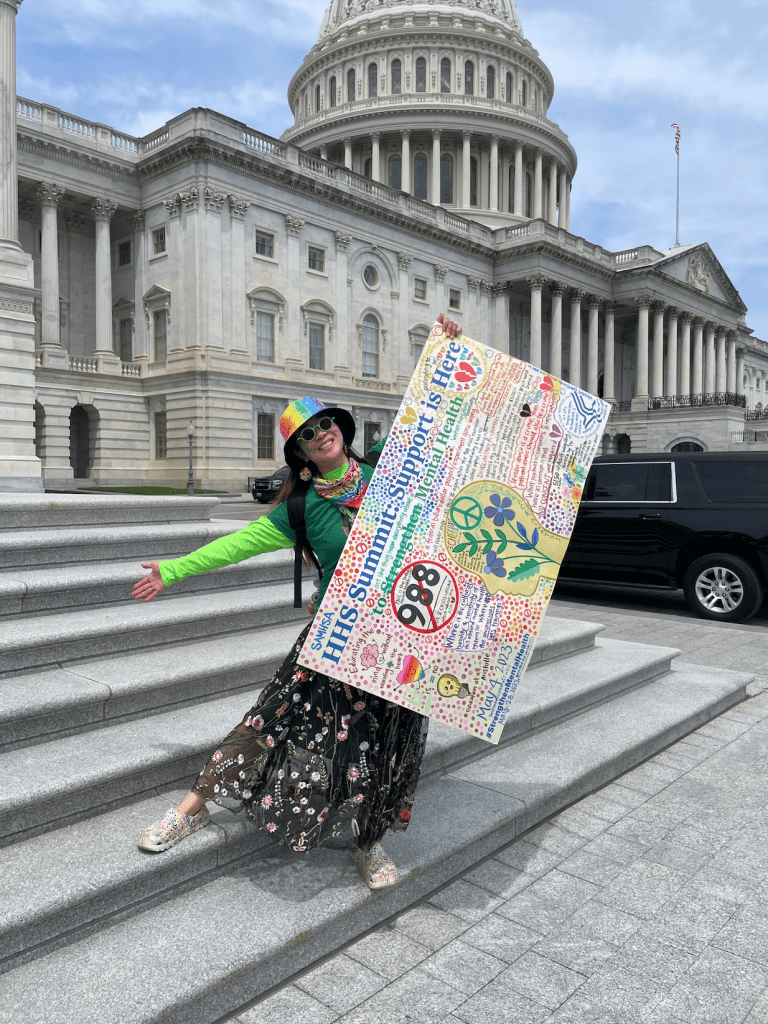
I have even worked on this art piece which balances my cynicism of 988 and rainbows, which I shared in DC while doing advocacy work with the National Coalition for Mental Health Recovery (NCMHR) in June 2025 & also showcased at an art show this past July. On the poster, I wrote, “You can’t grow if you’re not open to honest feedback.”
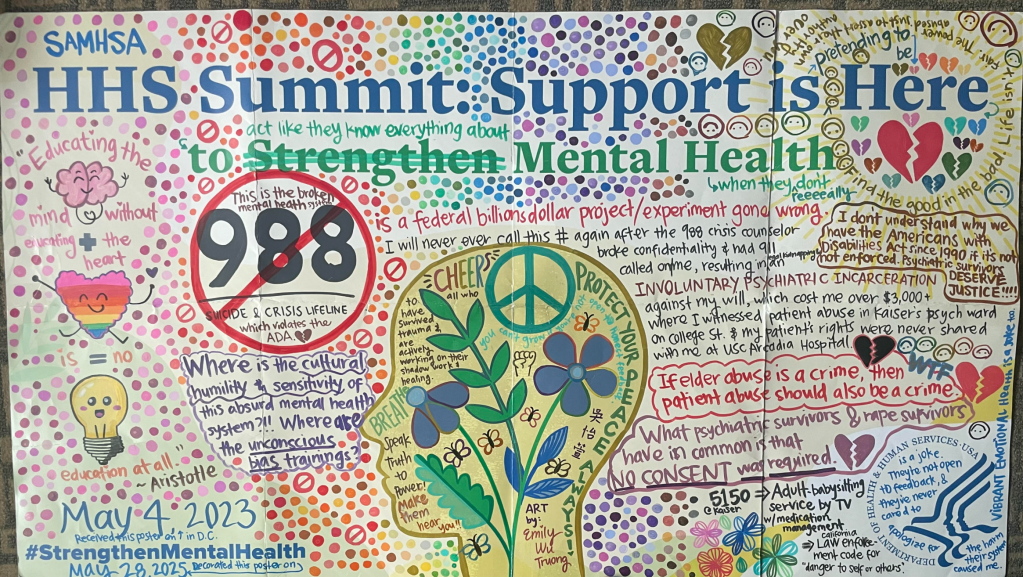
Redefining Crazy: They Built the Cage and Called It Care
Medium: Acrylic Paint on Cardboard Paper
This poster came from an event I had attended with the U.S. Department of Health and Human Services (HHS) on May 4, 2023 in Washington DC. On July 29, 2023, I experienced my first and only psychiatric incarceration for expressing suicidal ideation last 50 hours at USC Arcadia Hospital’s ER & Kaiser’s psychiatric ward on College St because I called the national suicide hotline 988. In May 2025, I decided to write my feedback onto the poster to reflect our broken mental healthcare system. To balance out the cynicism, I balanced it out with the rainbow polka dots, which is inspired by Japanese artist Yayoi Kusama who is 96 years old. She is mostly known for her bold, immersive, and surreal artworks that explore themes of infinity, repetition, self-obliteration, and mental health. The backside of this poster also says, “Nothing About Us Without Us,” which is a commonly used slogan used in the disability rights movement. No policy decisions should be made without direct involvement of the affected group. In June 2025, this poster almost got me arrested by the U.S. Capitol police on 3 separate occasions in DC while I was advocating with a group of psychiatric survivors and lived experience consultants with the National Coalition for Mental Health Recovery (NCMHR) and Faces & Voices of Recovery.
Thanks for reading! It’s actually been quite traumatizing to write this piece. I earnestly hope this experience never happens to you.
I’m honored by the leaders of Madwomen in the Attic for featuring me as a featured writer!
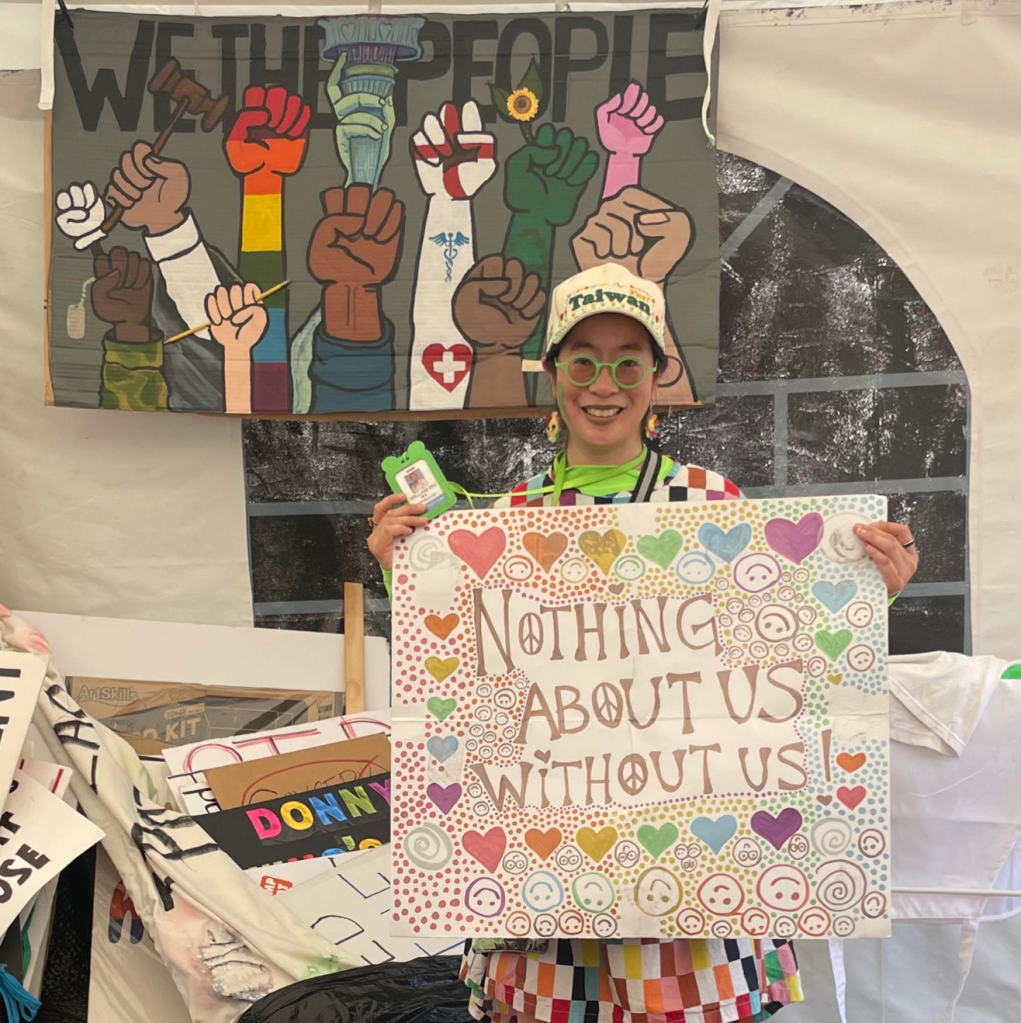

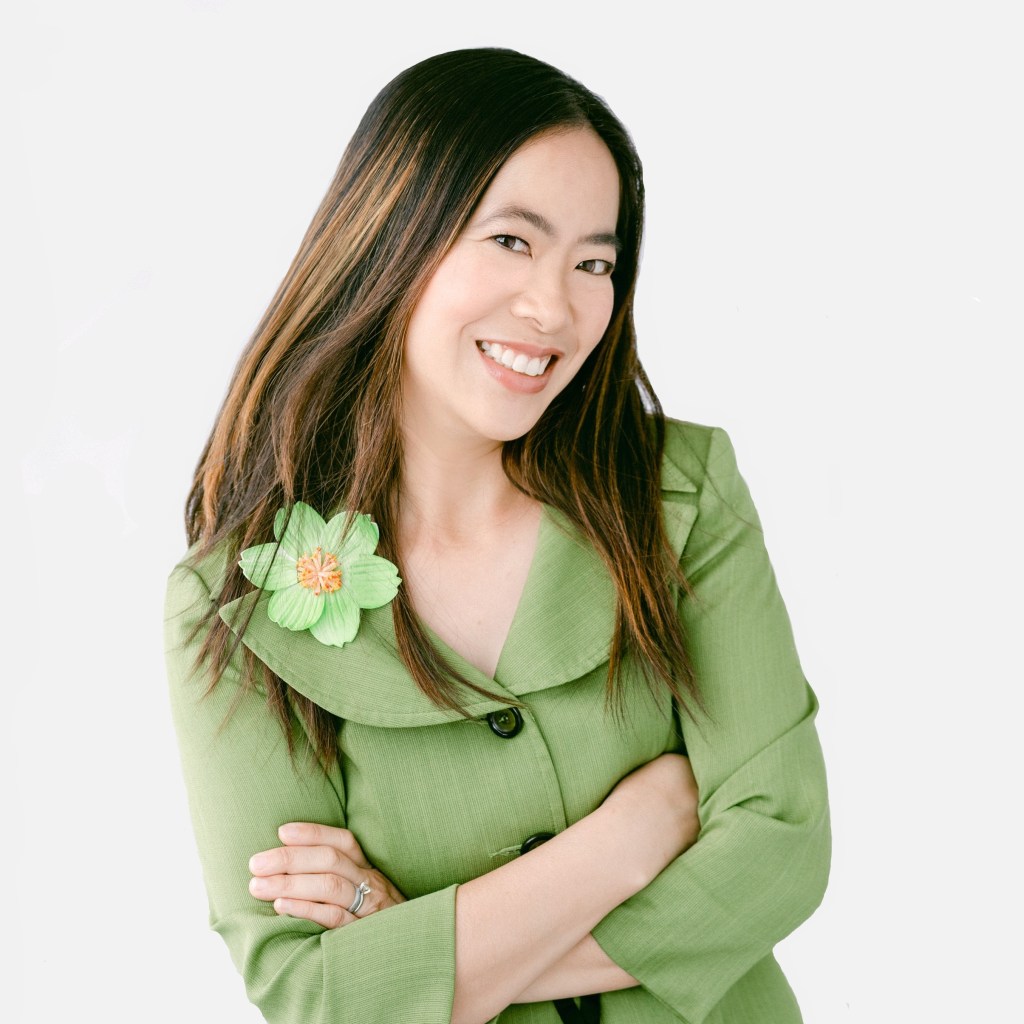
Emily Wu Truong (she / her / hers) is an award-winning Taiwanese American mental health advocate and Rainbow Grief Artist for trauma-informed care, harm-reduction, and systemic change to strengthen community resilience and healing. She learned to channel her grief energy into various art forms – singing, writing, dancing, playing the piano, & being a fashion statement for mental health in green and the LGBTQ movement in rainbow. Identifying as a suicide-attempt, sexual assault & psychiatric survivor, she serves as a motivational speaker and storyteller inspiring others to tap into their own inner strength. Invited to speak for former Congresswoman Grace Napolitano, Yale, Princeton, USC, TEDx and Raytheon, she was featured by the California Mental Health Movement when it was called “Each Mind Matters.” As a support group facilitator, she creates safe spaces for marginalized individuals with mental health disabilities. Emily serves as the first Asian American board member for the National Coalition for Mental Health Recovery (NCMHR). She also serves as a steering committee member for the National Asian American Pacific Islander Empowerment Network (NAAPIEN). She was named the 2024 AAPI Community Champion by former Senator Anthony Portantino and honored by The Alliance for Rights & Recovery for their Unsung Champions of Advocacy Award. Her advocacy, creative expression and dedication to community healing inspires many to transform their own pain into beauty.
 Madwomen in the Attic
Leave a comment