The Pill
She is small and elongated – capsule couching the deep-seated hurricanes of your heart. She hails from medicine mothers and Martians alike, feels like beads of a rosary at your fingertips.
She is split into two colors. One half is orange and the other is white – two halves of your fractured whole.
She is centuries of claims for happiness and how this can all go away if you just followed the right instructions. She means you sought professional help (despite being a problematic professional yourself).
She is pink. She is red or blue. Your colorblind lover asks which of her you placed into your mouth. You swallow before answering.
She is sometimes 5, 10, or 15 milligrams. Some days she’s 600 or 700. She demands to be taken once daily, you are compliant and gulp her down every 7 or 8 in the evening.
She took six years to come into your life. What is she teaching you about need and lack? Why must we consume things to silence what our bodies produce in abundance? Neurotransmitter, synapse, impulse – all these things overflowing from your blood.
She is not fruit or fuel but necessary for you to function.
She costs a lot. The local pharmacist knows you by face now, grants you the discounts apt for your predicament, but offers no sympathy as you pay the price.
She asks the difficult question of what and how much exactly is enough.
She is prayer and plea. Whose name do you taste on your tongue as you let her roll down your throat?
Aripiprazole
Her therapist said it would help her
stop making the wrong choices. Like fucking
people she didn’t love. Because she wanted something more
for her silly life. Thirteen going
on thirty-four. How does a body decide
what’s best for it? Synapse, signal, or the slightest touch?
She hails from a bloodline rife with sickness
certain to destroy the mind. Grandfather, father, sisters –
she’s so sorry
she couldn’t help you. She thought the bullet missed her
and here she is now, vomiting pizza slices and mush
after taking the prescribed medications. Now she understands
how it feels – this electricity running
in their veins. Her dosage keeps the voices at bay, but she sees
what it means to imagine oneself
as a god. Arms becoming wings
spanning continents:
infinity and ruin
two figures dancing
in a dream.
The Rorschach Test
After studying 300 mental patients and 100 control subjects, in 1921 Hermann Rorschach wrote his book Psychodiagnostik, which was to form the basis of the inkblot test. After experimenting with several hundred inkblots which he drew himself, he selected a set of ten for their diagnostic value
They say the first blot is a bat, butterfly, or moth mid-flight, instead she spots the face of a many-eyed fox in snow. Where does it want to go? The second image calls forth two praying rabbits – red-eared, pink-pawed. Others see this as two people huddled and facing each other. Dog, elephant, or bear are also common responses. The red calls forth sex, blood, or power, but all she thinks of is watercolor washing across a wilderness. Perhaps blood from a wound one did not mean to inflict? How much of people’s actions do they mean? The third card shows how one interacts with others. The correct answer is two people. Instead, she sees the face of a calf. What does this tell her about herself? The fourth blot spills ink generously forming the hide of an animal, carcass carpeting the floor. She sees a boar looking back at her, eyes empty before the slaughter, accepting of its fate. Fifth card: the moth flies to where the fox has hidden. Will you help her find them? Blot number 6: Water from a broken vase, splayed like hands tied at the wrist. How is this card supposed to be about sex? Feel free to moon about your ex-lovers. Consider all the things you swore you’d never do, and most especially not with him – how many of those things did you really never do? The seventh card shows her a boat, dividing the waters as it nears the end of its journey. Not a single siren in sight. How many times have you hurt other women? How many times have you turned a blind eye to the women you hurt? Blot number 8 is a burst of color: pale green, ultramarine, red, and orange. She sees the flayed spine of a skeleton. The ninth card is all color flowing downwards the page. She sees a coin making its way to the bottom of the ocean. Make a wish. The last card reveals more colors. She sees a rainbow skeleton of a chimera – limbs learning flight. Mirror image of itself as it leaps from the water.
These poems are forthcoming in my second poetry collection, Infinity and Ruin, a manuscript that explores bipolar disorder, medication, relapse, longing, and the difficult negotiations between illness and selfhood. In writing these pieces, I wanted to examine what it means to live inside a body and mind that are often translated by others into symptoms, diagnoses, prescriptions, and tests.
“The Pill,” “Aripiprazole,” and “The Rorschach Test” are poems about treatment, but they are also poems about agency. They ask what it means to need medication while at the same time resisting the reduction of the self into a case history. They ask how much of our pain is biological, inherited, chosen, inflicted, or misunderstood. They also ask what happens when the language meant to help us—clinical language, psychiatric language, pharmaceutical language—cannot fully contain the private weather of being alive.
As both a doctor and a patient of my own interior life, I am interested in the tension between care and control. Medicine can be lifesaving, but it can also be alienating. Diagnosis can offer clarity, but it can also become a cage. These poems live in that contradiction. They do not reject treatment, but they resist any system that treats Mad, mentally ill, or neurodivergent people as problems to be solved rather than people to be heard.
For me, writing about mental illness is not only confession; it is also witness. I write to make visible the shame, humor, grief, desire, and strange beauty that survive beneath psychiatric labels. I write toward a world where people affected by mental health systems can speak in their own metaphors, not only in the terms given to them by institutions. These poems are my attempt to claim that space.
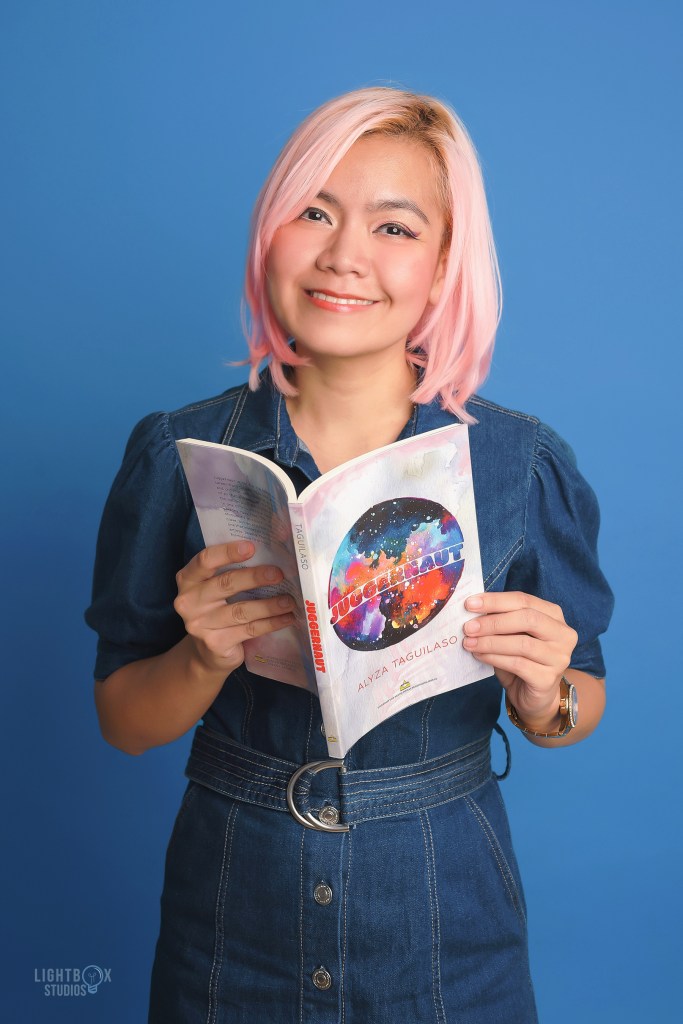
Alyza Taguilaso is a Filipina general surgeon and the author of Juggernaut (UST Publishing House), winner of the 25th Madrigal Gonzalez Best First Book Award and a finalist for the 43rd National Book Awards. Her second poetry collection, Infinity and Ruin, was awarded a National Book Development Board Publication Grant and is forthcoming from the UST Publishing House. Her poetry has been nominated for the Pushcart Prize and the Rhysling Award, and shortlisted in international contests including the Manchester Poetry Prize and the Bridport Poetry Prize. Her work appears in Electric Literature, Strange Horizons, Fantasy Magazine, The Deadlands, Canthius, Voice & Verse, Brave New Words, and the Philippines Free Press, among others. Find her online at @alyzataguilastorm on WordPress, @ventral and @doc.alyza on Instagram, and @lalalalalalyza on X.


Leave a Reply